

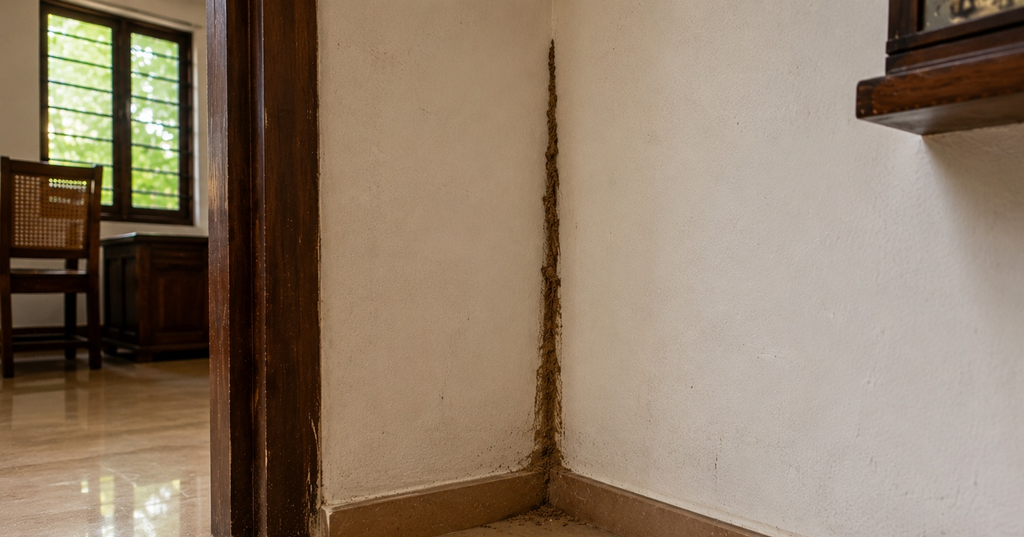
You notice a thin brown line running up your wall.
At first glance, it looks like dried mud or dirt. You wipe part of it away, assuming it’s nothing serious.
A few days later, it’s back.
This is one of the most common warning signs of an active termite infestation.
For homeowners in Kerala, especially during and after the monsoon, mud tubes are often the first visible evidence that termites are already inside the property. Unfortunately, by the time these tubes appear, the colony has usually been feeding on wooden structures for weeks or even months.
As pest management professionals with over 25 years of experience, we’ve inspected hundreds of homes where a simple mud tube turned out to be a widespread termite infestation hidden behind walls, beneath floors, or inside door frames.
In this guide, we’ll explain:
- What termite mud tubes are
- Why termites build them
- Why they’re common in Kerala
- How to identify them
- What you should do immediately
- When to call a professional
What Are Termite Mud Tubes?
Termite mud tubes are narrow tunnels built from soil, saliva, and tiny pieces of wood.
Subterranean termites construct these tunnels to travel safely between their underground colony and a food source, such as wooden doors, furniture, roof frames, or wall structures.
Unlike ants, termites cannot survive for long when exposed to sunlight or dry air. Their bodies lose moisture quickly.
Mud tubes solve this problem by creating a protected, humid passageway that allows termites to move while staying hidden from predators and environmental conditions.
Think of them as underground highways that extend onto your walls.
What Do Mud Tubes Look Like?
Mud tubes usually:
- Are brown or muddy in colour
- Measure about the width of a pencil
- Feel rough and dry on the outside
- Break easily when touched
- Often reappear after being removed if the colony is active
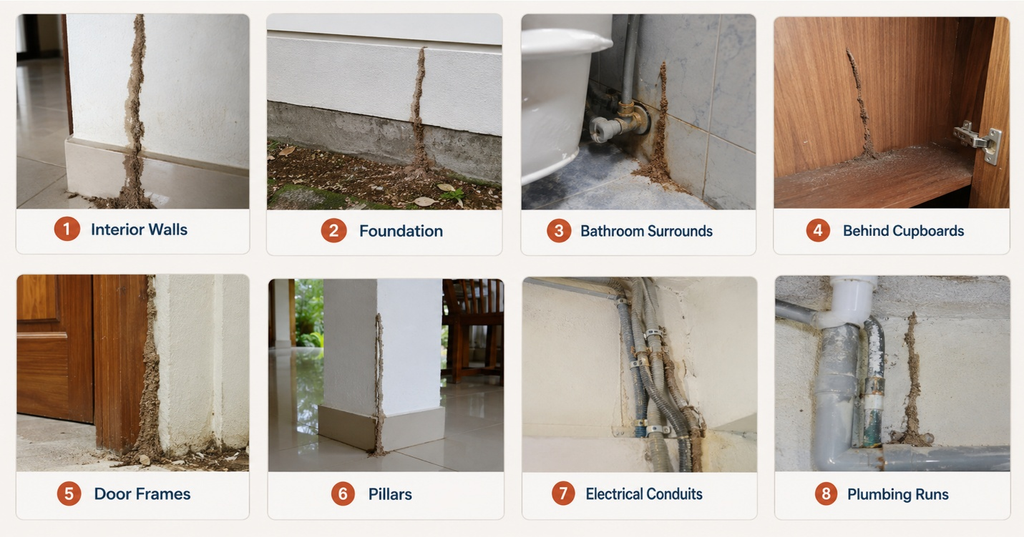
They can be found:
- On interior walls
- Along foundation walls
- Near bathrooms
- Behind cupboards
- Around wooden doors
- On pillars
- Near electrical conduits
- Along plumbing pipes
Why Are Mud Tubes So Common in Kerala?
Kerala provides ideal conditions for subterranean termites.
Several environmental factors contribute to their rapid growth:
1. High Humidity
Kerala experiences high humidity for much of the year.
Moist environments help termite colonies survive and expand faster.
2. Heavy Monsoon Rain
Monsoon rains soften the soil and increase moisture levels around building foundations.
This creates ideal conditions for termites to establish new tunnels.
3. Wooden Construction
Many Kerala homes include:
- Wooden doors
- Window frames
- Roof members
- Cabinets
- Decorative woodwork
These materials become attractive food sources for termites.
If you would like a fuller explanation of how monsoon groundwater physically pushes colonies upward into contact with your foundation, we cover the mechanism in our guide to why termite problems increase in Kochi homes during the monsoon.
4. Garden Landscaping
Trees, mulch, firewood, and untreated timber placed close to the house increase the chances of termites moving from the soil into the building.
Why Do Termites Build Mud Tubes?
Mud tubes serve several important purposes.
Protection from Dry Air
Termites require moisture to survive.
The tubes help maintain humidity while they travel.
Safe Travel
Open surfaces expose termites to predators such as ants and birds.
Mud tubes provide protection.
Access to Food
The tubes connect the underground colony directly to wooden structures.
This allows workers to transport food back to the colony continuously.
Are Mud Tubes Always a Sign of Active Termites?
Not always.
Sometimes, old mud tubes remain after a previous infestation.
The easiest way to check is:
Break a small section of the tube.
Observe it after a few days.
If termites rebuild the damaged section, there is likely active termite activity.
However, even if you don’t see termites immediately, it doesn’t guarantee the infestation is gone.
Professional inspection is still recommended.
Other Signs of Termite Infestation
Mud tubes are only one warning sign.
Look for:
Hollow Wooden Doors
Tap wooden surfaces.
If they sound hollow instead of solid, termites may have eaten the inside.
Bubbling Paint
Walls may appear to have water damage.
Sometimes this is actually caused by termite tunnels behind the surface.
Discarded Wings
Flying termites shed their wings after finding a new nesting location.
Small piles of transparent wings near windows or lights are an important warning sign.
Swarming is strongly tied to monsoon humidity and typically follows rainfall at dusk, which is why discarded wings and mud tubes are so often reported together in the same week.
Clicking Sounds
In quiet environments, large colonies sometimes produce faint clicking noises inside walls.
What Should You Do If You Find Mud Tubes?
Don’t Ignore Them
Many homeowners simply scrape away the mud.
Unfortunately, this does not solve the problem.
The colony usually remains underground.
Don’t Spray Household Insecticide
Surface sprays rarely reach the colony.
In some cases, they cause termites to move deeper into the structure, making treatment more difficult.
Inspect Nearby Wooden Areas
Check:
- Door frames
- Cabinets
- Furniture
- Roof timbers
- Skirting boards
- Staircases
Look for damage or hollow sections.
Schedule a Professional Inspection
A trained termite technician can determine:
- Whether the colony is active
- The extent of the damage
- The entry point
- The most suitable treatment method
Early intervention can significantly reduce repair costs.
Not every operator carries out this level of inspection. Before you book anyone, it is worth reading our guide to the 7 questions to ask before hiring a pest control company in Kerala, which covers licensing, chemical approval and what a warranty should actually say.
How Professionals Treat Termite Infestations
The treatment depends on the type and extent of infestation.
Common methods include:
Soil Treatment
A protective chemical barrier is created around the building to block termite entry.
This is one of the most effective methods for subterranean termites.
Post Construction Termite Treatment
Suitable for existing homes.
Small holes are drilled at strategic points, and termiticide is injected into the soil beneath the structure to create a continuous protective barrier.
Wood Treatment
Damaged wooden components may be treated directly to eliminate termites and protect against future attack.
Regular Monitoring
Periodic inspections help detect termite activity before significant damage occurs.
Full details of the methods we use, and how we select between them for a given property, are on our termite control services page.
How to Prevent Termites in Kerala Homes
While no property is completely termite-proof, these practices reduce the risk:
- Repair leaking pipes promptly.
- Prevent water accumulation near the foundation.
- Store firewood away from exterior walls.
- Avoid direct soil-to-wood contact.
- Remove dead tree roots and stumps.
- Schedule annual termite inspections.
- Seal cracks around plumbing and utility entry points.
Preventive maintenance is far less expensive than repairing structural termite damage.
When Should You Call a Pest Control Professional?
Contact a professional immediately if you notice:
- Active mud tubes
- Hollow wooden structures
- Flying termites indoors
- Multiple mud tunnels
- Reappearing mud tubes after removal
- Visible termite damage
Delaying treatment allows the colony to continue feeding and expanding.
You can book a free termite inspection with APCO and we will identify the species, map the extent of the activity and give you a written plan before you commit to anything.
Why Early Detection Matters
Termites work silently.
Unlike cockroaches or ants, they often remain hidden until substantial damage has already occurred.
The earlier an infestation is identified, the easier and more cost-effective it is to eliminate.
A small mud tube today can become extensive structural damage if ignored.
Frequently Asked Questions
What are termite mud tubes?
Termite mud tubes are protective tunnels made from soil, saliva, and wood particles. They allow subterranean termites to travel safely between their underground colony and food sources while retaining moisture.
Do mud tubes always mean I have termites?
Usually, yes. Mud tubes are one of the strongest indicators of subterranean termite activity. Even if no termites are visible, a professional inspection is recommended to determine whether the infestation is active.
Can I remove mud tubes myself?
You can physically remove them, but doing so will not eliminate the colony. If the termites are still active, they will often rebuild the tubes within days.
Why are termite infestations common in Kerala?
Kerala’s warm climate, high humidity, heavy monsoon rainfall, and widespread use of wooden building materials create ideal conditions for subterranean termites.
What happens if termite mud tubes are ignored?
Ignoring mud tubes can allow termites to continue feeding on wooden structures, leading to costly damage to doors, frames, furniture, flooring, and even structural components.
How often should my home be inspected for termites?
Homes in Kerala should ideally have a professional termite inspection at least once a year, especially before or after the monsoon season.
Can termites damage concrete walls?
Termites do not eat concrete, but they can travel through cracks, expansion joints, and gaps in masonry to reach wooden materials inside the building.
What is the most effective termite treatment for an existing home?
For most existing homes, post-construction termite treatment combined with a professionally applied soil barrier is one of the most effective long-term solutions for subterranean termites.
Final Thoughts
A mud tube on your wall is more than just dried soil. It’s often the visible tip of a hidden termite problem that could be damaging your home around the clock.
If you notice mud tubes, avoid relying on DIY fixes or waiting to see if the problem gets worse. A professional inspection can identify the source, assess the extent of the infestation, and recommend the most effective treatment before the damage becomes more extensive.
Protecting your home starts with acting early.
Book a free inspection Today.
